
Abstract
This research finds barriers/challenges/issues which stop women of Khairpur, Sindh not to get themselves enrolled in institutions providing STEM education and ultimately the job opportunities, resultantly that not only affects the economic condition of their families but also that of the country. The universe of this study was the young female students, parents of the students and ladies working in different organizations of Sind province who were also interviewed about the low enrollment of female students in schools. The findings of this study revealed that female have the requisite aptitude for STEM education but social, cultural and conservative ideology of parents/heads of the families created hindrances in the progress of young enthusiastic girls who wish or have the potential of getting STEM education, moreover, such institutes are not available in their nearby area.
Key Words
STEM Education, Social/Cultural/Economic Barriers
Introduction
Most of the people including educators, students, and common people the exact meaning of STEM education, when they hear ‘STEM’ their attention is drawn to the stem of a plant (Angier, 2010). However, STEM stands for Science, Technology, Engineering, and Mathematics. This was the idea the first time used by the president of the USA when he was addressing the State of the Union on January 25, 2011. STEM Education was originally called Science, Mathematics, Engineering, and Technology (SMET) (Sanders, 2009), and it was an initiative created by the National Science Foundation (NSF). The purpose of this initiative was to motivate young people to get this education to develop critical thinking skills, and to make them creative which will ultimately increase their value in the job market. According to Butz et al. (2004) those students who get STEM education at a lower level, they got the advantage, even if they do not get it at a higher level, over other students who do not get STEM education. If we read history we find that the concept of STEM was earlier introduced in the business world years back, especially during the industrial revolution Thomas Edison and other scientists used this term in traditional settings. In the beginning, STEM was used in engineering related firms with the purpose to bring revolution in technologies like light bulbs, automobiles, tools, and machines, etc. the people who were responsible were this innovation was not educated they did some kind of apprenticeship, they started this movement in education. Beals (2012) considers neither Edison nor Ford attended any college but they worked together for years to support each other. They are giants in the history of technology who revolutionized the world by following the principles of STEM but this term was not virtual in the field of education. STEM became part of education because of several historical events, and among those was the Morrill Act of 1862. This Act focuses on the establishment of universities, initially, these were agricultural universities but later on, they started technologies or engineering-based programs. As in 1870 Ohio Agriculture and Mechanical College were established but later it was upgraded to Ohio State University, the lands were given to the universities and with time, it started STEM-related programs. Other such events that pushed STEM education were WW-II and the launch of the Soviet Union’s Sputnik.
The above-mentioned definitions are well-known descriptive definitions of STEM, but in this field, Science and Mathematics are at the top because these are most popular fields and could be the part of academia, while Technology and Engineering are the professional fields but also are not heavily funded as not considered part of education (Miaoulis, 2011). Now the integration of these areas is necessary for the academic fields. For the purpose, the educationists need to change their interpretation when people will understand it better than resulting in more progress and development in this contemporary era.
Eccles, Jacobs, & Harold, (1990) write that children learn about gender roles at a very early stage. It is a common perception that females are more socially skilled and have helping nature, which means they are better in interpersonal relationships (Konrad, Ritchie, Lieb, & Corrigall, 2000). While it is thought that boys are good at acquiring mastery and skills competence, they try to explore the world, struggle to understand how things are working, have problem-solving nature, and always looking after financial matters. In the same way, common people are connecting gender roles with Mathematics and Science, but these are unrelated to the real world (Buck, Leslie-Pelecky, & Kirby, 2002). We find more boys learning mathematics than girls (National Science Foundation [NSF], 2003), but this was not the situation in the USA only if we see Pakistan we find the same situation that boys are good in Mathematics while girls avoid or take substitute of Mathematics. As girls listen to this statement from age 6 to 7 years and this becomes part of their personality till the age of 10 that they cannot learn Mathematics, therefore, they take less and go for biology or other subjects (Herbert & Stipek, 2005). Hyde, Fennema, and Lamon, (1990) argues that performance at the adolescence level. Simpkins, Davis-Kean, & Eccles, (2006) say that selection of subjects depends upon the parents’ role if parents provide opportunities to their children related to STEM education, resultantly more children will take STEM-related subjects without discrimination of gender. Parents’ beliefs in their children's efforts and abilities build the confidence of their children and they score good grades (Frome, & Eccles, 1998). It is observed that when the girls are studying at middle or high school level more mothers are seen forcing girls to take STEM subjects than fathers (Leaper, Farkas, & Brown, 2012). Yee & Eccles, (1992) revealed through their research that gender discrimination related to the choice of subjects is more propagated from mothers’ sides rather than fathers. In short, we can conclude that social play a great role in the selection and promotion of STEM-related subjects. 1973 Constitution of Pakistan gives equal rights to both genders but in Pakistan, females are considered to do household works while males are supposed to earn the living, this is not the trend in rural areas but the same thoughts are prevailing in the cities. But with time, the trends are changing people are becoming broadminded and are ready to provide opportunities to their children without discrimination of gender difference, although the pace of change is slow (Qureshi, & Rarieya, 2007). The governments in Pakistan have worked for providing opportunities to females from all walks of life by fixing their quota but still, they have to do a lot for the independence of females. Haq (2000) says that if we developed or such countries which have sufficient resources and their economy is strong we do not find any of the countries which have achieved that level with the contribution of females. Educated ladies have done a lot for the development of their nation. The present situation of Pakistan is alarming we can bring Pakistan out by providing opportunities to females when mothers will be educated they will play their role which is significant for the development of our nation. According to Mishra (2005), research has proved that without expansion of basic education among females’ economic development is difficult. Education is considered the most valuable thing that not only improves the living style of the person, helps in earning but brings an overall change in the personality of a person. As we do not understand reality and in this regards education widens the horizons of experiences and helps in understanding reality (Nayak and Nair, 2005). Its helps women in playing their social role more effectively. According to Mishra (2005), when girls will be educated they will become educated mothers and will ultimately send their children to school, provide them better moral education at home and in this awareness about benefits of education will be multiplied. Education will help girls in managing home-related matters in a better way (Goel, 2004). Education helps women to mitigate the problems which hinder their way to progress (Mishra, 2005). Although education does not facilitate women in lessening the labor they but somehow help them in controlling their role of reproduction of humans and understanding and demanding their rights for which they deserve and also improve their domestic lives.
Statement of the Problem
In Pakistan females who are more than half of the population are not only allowed to get an education but if
allowed then they find several barriers in their ways in achieving their goals. Moreover, in the field of science few females are competing males and this situation is worse in rural areas particularly of Sindh.
Research Questions
Following are research questions:
i. Are females of Sindh interested in STEM education?
ii. How many girls are enrolled at different levels i.e. higher secondary, and technical colleges or engineering universities?
iii. What is the ratio of dropout of girl students from one level to the next?
iv. What are the barriers which hinder their way to get STEM education?
v. What are the effects of females lacking education in STEM on women themselves, their families and ultimately the nation?
vi. How can the issues faced by the women of Sindh be addressed?
Methodology
For the present research study both approaches were adopted; quantitative to provide a guideline or to get the required information from the respondents and qualitative approach to know their inner true feelings because some social scientists feel that when you ask close-ended questions, you put your words in the respondent's mouth while some social scientist feel that when open-ended questions were asked from a respondent, maybe at that time the respondent was not in good mood, unable to recall the situation to answer, may behave lack of information or may be unable to give proper relative required information.
To collect quantitative information, questionnaire(s) consisting of close-ended questions having Likert-scale options i.e. SD/SD = 0, D/D = 1, N/N = 2, A/A = 3, and Strongly A/SA = 4 were formed. These questions were developed based on the literature reviewed or information collected from different sources or the researcher's point of view due to their/his observations, and the purpose was to verify the issues discussed or observed or highlighted by the research scholars or critics. While for qualitative data open-ended questions were developed to get the real feel of the respondents. In this regard, one of the qualitative methods named ‘Phenomenological Approach’ was adopted, this approach helps in getting true feelings or real data.
Universe
The universe of the present research study was students, parents, and women working in different organizations only because of STEM education.
Sampling Procedure
The stratified random sampling procedure was adopted for data collection from the female students, while the snowball sampling procedure was adopted for data collection from parents and working ladies because findings parents and working ladies were a bit difficult.
Sample
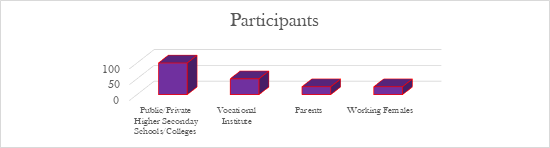
To get the answers for questions 2 and 3, data were collected from 100 girls studying in the available higher secondary school/colleges, and 50 in technical colleges present in the district Khairpur. But to get the answers to the research questions 1, 4, 5 and 6, data were collected from 25 each parent and women working in different organizations.
Data Collection
Data were collected using a survey method by visiting institutes and the concerned people. The detail is as under:
Table 1. The Detail of Available Institutes in District Khairpur
| Education Institutions | > S. No. width="187" valign="top">Type of Institute width="126">Males width="130">Females width="115">Total | > 1 width="187" valign="top">Intermediate College width="126">-- width="130">-- width="115">-- | > 2 width="187" valign="top">Degree width="126">10 width="130">5 width="115">15 | > 3 width="187" valign="top">Technical Colleges width="126">1 width="130">-- width="115">1 | > 4 width="187" valign="top">Polytechnic Institutes width="126">2 width="130">-- width="115">2 | > 5 width="187" valign="top">Monotechnic Institues width="126">2 width="130">-- width="115">2 | > 6 width="187" valign="top">Commercial Institutes width="126">3 width="130">-- width="115">3 | > 7 width="187" valign="top">Vocational Institutes width="126">1 width="130">6 width="115">7 | > 8 width="187" valign="top">Engineering Universities width="126">-- width="130">-- width="115">-- | ||||
Table 1 (Sindh Statistical Burure)
Table 2. The Enrollment of Male and Female Students in the Available Institutes
| Male & Female Enrolment | > S. No. width="187">Type of Institute width="126">Males width="130">Females width="115">Total | > 1 width="187">Intermediate College width="126">-- width="130">-- width="115">-- | > 2 width="187">Degree width="126">12532 width="130">5248 width="115">17780 | > 3 width="187">Technical Colleges width="126">1199 width="130">-- width="115">1199 | > 4 width="187">Polytechnic Institutes width="126">481 width="130">-- width="115">481 | > 5 width="187">Monotechnic Institues width="126">547 width="130">-- width="115">547 | > 6 width="187">Commercial Institutes width="126">93 width="130">-- width="115">93 | > 7 width="187">Vocational Institutes width="126">59 width="130">176 width="115">235 | > 8 width="187">Engineering Universities width="126">-- width="130">-- width="115">-- | ||||
Table 2 (Sindh Statistical Burure)
According to Sindh at a Glance (2018), literacy among young women (15 to 24 years) is 52.3%.
Analysis
The collected quantitative data using questionnaires were analyzed by using SPSS while qualitative data by sorting, labeling and quantifying.
Sample

| S. No. width="282" valign="top">Institute width="154">No of Participants | > 1 width="282" valign="top">Public/Private Higher Secondary Schools/Colleges width="154">100 | > 2 width="282" valign="top">Vocational Institute width="154">50 | > 3 width="282" valign="top">Parents width="154">25 | > 4 width="282" valign="top">Working Females width="154">25 | > Total width="154">200 | |
Importance of STEM Education for Females
width="78">
F
width="69">P
width="93">V P
width="98">C P
width="100" valign="top">
N
width="78">8
width="69">8.0
width="93">8.0
width="98">8.0
A
width="78">4
width="69">4.0
width="93">4.0
width="98">12.0
SA
width="78">88
width="69">88.0
width="93">88.0
width="98">100.0
Total
width="78">100
width="69">100.0
width="93">100.0
width="98">
| Females Aptitude for STEM Education | > width="78"> F width="68">P width="93">V P width="98">C P | > width="100" valign="top"> N width="78">26 width="68">26.0 width="93">26.0 width="98">26.0 | > A width="78">5 width="68">5.0 width="93">5.0 width="98">31.0 | > SA width="78">69 width="68">69.0 width="93">69.0 width="98">100.0 | > Total width="78">100 width="68">100.0 width="93">100.0 width="98">
| ||||||
| Difficulties in Learning STEM-Related Education | > width="78"> F width="69">P width="94">V P width="99">C P | > width="101" valign="top"> N width="78">19 width="69">19.0 width="94">19.0 width="99">19.0 | > A width="78">19 width="69">19.0 width="94">19.0 width="99">38.0 | > SA width="78">62 width="69">62.0 width="94">62.0 width="99">100.0 | > Total width="78">100 width="69">100.0 width="94">100.0 width="99">
| ||||||
| Parents Support in Getting STEM-Related Education in Other District | > width="78"> F width="69">P width="93">V P width="98">C P | > width="100" valign="top"> N width="78">45 width="69">45.0 width="93">45.0 width="98">45.0 | > A width="78">19 width="69">19.0 width="93">19.0 width="98">64.0 | > SA width="78">36 width="69">36.0 width="93">36.0 width="98">100.0 | > Total width="78">100 width="69">100.0 width="93">100.0 width="98">
| ||||||
| Have Issue in Attending STEM Education with Males | > width="78"> F width="69">P width="93">V P width="98">C P | > width="120" valign="top"> SD width="78">14 width="69">14.0 width="93">14.0 width="98">14.0 | > D width="78">8 width="69">8.0 width="93">8.0 width="98">22.0 | > N width="78">29 width="69">29.0 width="93">29.0 width="98">51.0 | > A width="78">19 width="69">19.0 width="93">19.0 width="98">70.0 | > SA width="78">30 width="69">30.0 width="93">30.0 width="98">100.0 | > Total width="78">100 width="69">100.0 width="93">100.0 width="98">
| ||||||
| Importance of STEM Education for Females | > width="78"> F width="69">P width="93">V P width="98">C P | > width="120" valign="top"> SD width="78">7 width="69">14.0 width="93">14.0 width="98">14.0 | > D width="78">2 width="69">4.0 width="93">4.0 width="98">18.0 | > N width="78">8 width="69">16.0 width="93">16.0 width="98">34.0 | > A width="78">11 width="69">22.0 width="93">22.0 width="98">56.0 | > SA width="78">22 width="69">44.0 width="93">44.0 width="98">100.0 | > Total width="78">50 width="69">100.0 width="93">100.0 width="98">
| ||||||
| Have Issue in Attending STEM Education with Males | > width="78"> F width="69">P width="93">V P width="98">C P | > V width="120" valign="top">SD width="78">7 width="69">14.0 width="93">14.0 width="98">14.0 | > D width="78">2 width="69">4.0 width="93">4.0 width="98">18.0 | > N width="78">8 width="69">16.0 width="93">16.0 width="98">34.0 | > A width="78">11 width="69">22.0 width="93">22.0 width="98">56.0 | > SA width="78">22 width="69">44.0 width="93">44.0 width="98">100.0 | > Total width="78">50 width="69">100.0 width="93">100.0 width="98">
| ||||||
Difficulties in Learning STEM Related-Subjects
width="78">
F
width="69">P
width="93">V P
width="98">C P
width="120" valign="top">
SD
width="78">2
width="69">4.0
width="93">4.0
width="98">4.0
D
width="78">6
width="69">12.0
width="93">12.0
width="98">16.0
N
width="78">10
width="69">20.0
width="93">20.0
width="98">36.0
A
width="78">14
width="69">28.0
width="93">28.0
width="98">64.0
SA
width="78">18
width="69">36.0
width="93">36.0
width="98">100.0
Total
width="78">50
width="69">100.0
width="93">100.0
width="98">
| Parents' Support in Getting STEM Education in other District | > width="78"> F width="69">P width="93">V P width="98">C P | > width="120" valign="top"> SD width="78">6 width="69">12.0 width="93">12.0 width="98">12.0 | > N width="78">32 width="69">64.0 width="93">64.0 width="98">76.0 | > A width="78">2 width="69">4.0 width="93">4.0 width="98">80.0 | > SA width="78">10 width="69">20.0 width="93">20.0 width="98">100.0 | > Total width="78">50 width="69">100.0 width="93">100.0 width="98">
| ||||||
| Have Issue in Attending Classes with Males Male Students | > width="78"> F width="69">P width="93">V P width="98">C P | > width="100" valign="top"> N width="78">22 width="69">44.0 width="93">44.0 width="98">44.0 | > A width="78">1 width="69">2.0 width="93">2.0 width="98">46.0 | > SA width="78">27 width="69">54.0 width="93">54.0 width="98">100.0 | > Total width="78">50 width="69">100.0 width="93">100.0 width="98">
| ||||||
| Importance of STEM Education | > width="78"> F width="68">P width="93">V P width="98">C P | > V width="100" valign="top">N width="78">15 width="68">60.0 width="93">60.0 width="98">60.0 | > SA width="78">10 width="68">40.0 width="93">40.0 width="98">100.0 | > Total width="78">25 width="68">100.0 width="93">100.0 width="98">
| ||||||
| The interest of Daughters in STEM Education | > width="78"> F width="69">P width="93">V P width="98">C P | > width="120" valign="top"> SD width="78">4 width="69">16.0 width="93">16.0 width="98">16.0 | > D width="78">3 width="69">12.0 width="93">12.0 width="98">28.0 | > N width="78">13 width="69">52.0 width="93">52.0 width="98">80.0 | > A width="78">1 width="69">4.0 width="93">4.0 width="98">84.0 | > SA width="78">4 width="69">16.0 width="93">16.0 width="98">100.0 | > Total width="78">25 width="69">100.0 width="93">100.0 width="98">
| ||||||
| Want Your Daughters Get STEM Education | > width="78"> F width="69">P width="93">V P width="98">C P | > V width="120" valign="top">SD width="78">3 width="69">12.0 width="93">12.0 width="98">12.0 | > D width="78">5 width="69">20.0 width="93">20.0 width="98">32.0 | > N width="78">4 width="69">16.0 width="93">16.0 width="98">48.0 | > A width="78">9 width="69">36.0 width="93">36.0 width="98">84.0 | > Strongly A width="78">4 width="69">16.0 width="93">16.0 width="98">100.0 | > Total width="78">25 width="69">100.0 width="93">100.0 width="98">
| ||||||
| Importance of STEM Education | > width="78"> F width="68">P width="93">V P width="101">C P | > V width="100" valign="top">D width="78">2 width="68">8.0 width="93">8.0 width="101">8.0 | > N width="78">3 width="68">12.0 width="93">12.0 width="101">20.0 | > A width="78">8 width="68">32.0 width="93">32.0 width="101">52.0 | > SA width="78">12 width="68">48.0 width="93">48.0 width="101">100.0 | > Total width="78">25 width="68">100.0 width="93">100.0 width="101">
| ||||||
| STEM Education and Job Opportunities | > width="78"> F width="69">P width="93">V P width="98">C P | > width="100" valign="top"> N width="78">3 width="69">12.0 width="93">12.0 width="98">12.0 | > A width="78">14 width="69">56.0 width="93">56.0 width="98">68.0 | > SA width="78">8 width="69">32.0 width="93">32.0 width="98">100.0 | > Total width="78">25 width="69">100.0 width="93">100.0 width="98">
| ||||||
| STEM Education and Change in Pakistan | > width="78"> F width="69">P width="93">V P width="98">C P | > width="120" valign="top"> SD width="78">4 width="69">16.0 width="93">16.0 width="98">16.0 | > D width="78">3 width="69">12.0 width="93">12.0 width="98">28.0 | > N width="78">3 width="69">12.0 width="93">12.0 width="98">40.0 | > A width="78">9 width="69">36.0 width="93">36.0 width="98">76.0 | > SA width="78">6 width="69">24.0 width="93">24.0 width="98">100.0 | > Total width="78">25 width="69">100.0 width="93">100.0 width="98">
| ||||||
Discussion
These responses help us in understanding the situation as 88% of female students, 22% of females getting vocational training, 10% of parents and 6% working females chose the option strongly A to keep in view the importance of STEM education. 69% of female students feel that they have the required aptitude for STEM Education. 62% of female students find difficult STEM education subjects. 45% of female students chose the option ‘N’ when asked will their parents support them in case if they have to go to another district for STEM education. 30% of female students chose the option ‘strongly A’ in case of getting an education with male students. 44% of female students of vocational institutes chose the option ‘Strongly A’ in case of getting STEM-education with males. 36% of females’ students of vocational institutes chose the option ‘Strongly A’ in case of facing difficulties when getting STEM-education. 64% of female students of vocational institutes chose the option ‘N’ in case of getting STEM-education in other districts. 54% of females’ students of vocational institutes choose the option ‘Strongly A’ in case of getting STEM-Education with males. 52% of parents chose the option ‘N’ for providing STEM Education to their daughters. 36% of parents chose option ‘A’ that they want to get STEM education. 42% of parents feel that no STEM education providing institute is available in their vicinity. 40% of parents feel the establishment of STEM education institutions in their vicinity is the solution to the problem. 56% of working females Ad that STEM education provides better job opportunities for females. 36% of working females Ad that STEM education for females can bring Pakistan on the right track for progress. 61% of working females feel that males’ dominant office environment is an issue for them. 87% of working females feel the facility of transport is the solution for females to get STEM education
Conclusion
As options chosen by maximum numbers of respondents were taken in the discussion part, therefore based on that maximum numbers of respondents understand the importance of STEM education. The required aptitude for STEM education is present in females, but such institutes are present in their nearby vicinity, therefore parents are reluctant in sending their daughters to other districts. Establishment of STEM education providing institute for females in nearby vicinity is the solution for the problem and that can keep Pakistan on the right track of progress.
Recommendations
Based on conclusions drawn from the discussion, it is recommended that:
• Institutes providing STEM education should be established for female students
• The government should provide sufficient funds for laboratory equipment.
Figure 1
References
- Ahmed, L. (1992). Women and gender in Islam. New York: Yale University
- Aikman, S. & Unterhalter, E. (2005). The education MDGs: achieving gender equality through curriculum and pedagogy change. Gender and Development, 13:1, 44 -55
- Aikman, S. & Unterhalter, E. (eds.) (2005). Beyond Access: Transforming, Policy and Practice for Gender Equality in Education. London: Oxfam
- Angier, N. (2010, October 04). Stem education has little to do with flowers. New York Times. Retrieved from
- Arnot, M. (2002). Reproducing gender?: Essays on educational theory and feminist. London: Rutledge. Background of Ohio State. (2012). Retrieved January 21, 2012, from
- Barakos, L., Lujan, V., & Strang, C. (2012). Science, technology, engineering, mathematics (STEM): Catalyzing change amid the confusion. Portsmouth, NH: RMC Research Corporation, Center on Instruction
- Basit, T.N. (1997). Eastern Values, Western Milieu: Identities and Aspirations of Adolescent British Muslim Girls. Aldershot: Ash gate. www.ccsenet.org/ass Asian Social Science Vol. 7, No. 2; February 2011 Published by Canadian Center of Science and Education 87
- Batliwala, S. (1994). The Meaning of Women's Empowerment: New Concepts from Action. In Sen, G., Germain. A. and Chen, L. (eds.) Population Policies Reconsidered. Health, Empowerment, and Rights. Cambridge: Harvard University Press, pp. 127-38
- Beals, J. (2012). Thomas edison.com. Retrieved April 30, 2012, from
- Butz, W. P., Kelly, T. K., Adamson, D. M., Bloom, G. A., Fossum, D., & Gross, M. E. (2004). Will the scientific and technology workforce meet the requirements of the federal government? Pittsburgh, PA: RAND
- Coate, K. (1999). Feminist Knowledge and the Ivory Tower: a case study. Gender and Education, Vol. 11, No. 2, pp. 141-159
- David, M. (1993). Parents, Gender & Education Reform. London: Black Well Publication. Francis, B. & Skelton, C. (eds.) (2001). Investigating gender: Contemporary Perspectives in Education. Buckingham: Open University Press.
- Gaskell, J, Eichler, M., Pan, J., Xu, J. & Zhang, X. (2004). The participation of women faculty in Chinese universities: paradoxes of globalization. Gender and Education, Vol. 16, No. 4
- Goel, A. (2004). Education and Socio-Economic Perspectives of Women Development and Empowerment.
- Hashemi, S., Schuler, M. & Riley, A. (1996). Rural Credit Programs and Women's Empowerment in Bangladesh. World Development, 24(4), pp.635-53.
- Heyzer, N. (2005). Making the links: women's rights and empowerment are key to achieving the millennium development goals 1. Gender & Development, 13:1, 9 -12.
- International Technology and Engineering Education Association. (2011). Technology for All Americans Project. Reston, VA: Author
- Kabeer, N. (2005). Gender equality and women's empowerment: a critical analysis of the third-millennium development goal. Gender & Development, 13:1, 13 -24
- Kazi, S & Sathar, A. (1996). Explaining Fertility in Rural Punjab: The Role of Gender Development, Paper presented at IUSSAP conference on comparative perspective on fertility transition in South Asia, Rawalpindi, Pakistan, 17-19 December
- Kelly, B. (2012, September). Stem: What it is, and why we should care. U.S. News and World Report, Retrieved from
- Miaoulis, I. (2011). Museums key to stem success. U.S. News and World Report, Retrieved from
- Mishra R.C. (2005). Women in Education. New Delhi: A.P.H Publishing Corporation.
- National Aeronautics and Space Administration, (2012). Nasa by 2012 budget estimates, education. Retrieved from website:
- National Aeronautics and Space Administration. (2008). Sputnik and the dawn of the space age. Retrieved November 5, 2011, from
- Nayak S. & Nair, J. (2005). Women Empowerment in India. Jaipur: Pointer Computers. Qureshi, R, and Rarieya, F.A. (eds) (2007). Gender and Education in Pakistan. Karachi: Oxford University Press.
- Radford, J. (ed.) (2000). Education, Equality, andHuman rights: Issues of gender, race, and sexuality. London: Rutledge
- Ringrose, J. (2007). Successful Girls? Complicating post-feminist, neoliberal discourses of educational achievement and gender equality. Gender and Education, Vol. 19, No. 4, pp. 471-489.
- Robinson-Pant, A. (2004). Education for women: whose values count? Gender and Education, Vol. 16, No. 4, pp. 473-489
- Sanders, M. (2009) STEM, STEM education, STEMmania. The Technology Teacher, 68(4). 20-26
- Stein, J. (1997). Empowerment and Women's Health: Theory, Method, and Practice. London: Zed Books
- Technology. (n.d.). Dictionary.com Unabridged. Retrieved May 20, 2012, from Dictionary.com website:
- Verma. (2006). Gender, Girls and Women Education. New Delhi: Murari Lal & Sons
- West, J. & Lyon, K. (1999). The Trouble with Equal Opportunities: the case of women academics. Gender and Education, V o l. 7, No. 1.
- Whitehouse.gov (2011). Remarks by the President in State of Union Address. Retrieved January 10, 2012, from
Cite this article
-
APA : Shaikh, M. A., Sahito, Z. H., & Dehraj, M. A. (2019). Stem Education: Social, Cultural, and Economic Barriers Faced by Women of Khairpur (Pakistan). Global Regional Review, IV(II), 392-403. https://doi.org/10.31703/grr.2019(IV-II).42
-
CHICAGO : Shaikh, Muhammad Ali, Zahid Hussain Sahito, and Mahboob Ali Dehraj. 2019. "Stem Education: Social, Cultural, and Economic Barriers Faced by Women of Khairpur (Pakistan)." Global Regional Review, IV (II): 392-403 doi: 10.31703/grr.2019(IV-II).42
-
HARVARD : SHAIKH, M. A., SAHITO, Z. H. & DEHRAJ, M. A. 2019. Stem Education: Social, Cultural, and Economic Barriers Faced by Women of Khairpur (Pakistan). Global Regional Review, IV, 392-403.
-
MHRA : Shaikh, Muhammad Ali, Zahid Hussain Sahito, and Mahboob Ali Dehraj. 2019. "Stem Education: Social, Cultural, and Economic Barriers Faced by Women of Khairpur (Pakistan)." Global Regional Review, IV: 392-403
-
MLA : Shaikh, Muhammad Ali, Zahid Hussain Sahito, and Mahboob Ali Dehraj. "Stem Education: Social, Cultural, and Economic Barriers Faced by Women of Khairpur (Pakistan)." Global Regional Review, IV.II (2019): 392-403 Print.
-
OXFORD : Shaikh, Muhammad Ali, Sahito, Zahid Hussain, and Dehraj, Mahboob Ali (2019), "Stem Education: Social, Cultural, and Economic Barriers Faced by Women of Khairpur (Pakistan)", Global Regional Review, IV (II), 392-403
-
TURABIAN : Shaikh, Muhammad Ali, Zahid Hussain Sahito, and Mahboob Ali Dehraj. "Stem Education: Social, Cultural, and Economic Barriers Faced by Women of Khairpur (Pakistan)." Global Regional Review IV, no. II (2019): 392-403. https://doi.org/10.31703/grr.2019(IV-II).42